In this issue:
1. AI safety vs. regulatory capture
2. What AI regulation could mean for investors
01 — THE SIGNAL
Revenge of the Frontier Labs
The AI safety fight broke into the open this month and has been covered everywhere, so we will keep the recap short. On September 8, a pretraining researcher named Jacob Coxon resigned from Anthropic and posted a thread saying the leading labs are racing to self-improving superintelligence and gambling with our lives. It has been viewed more than 170 million times. Four days later Dario Amodei published an essay arguing that the industry must slow the rate at which it improves model capabilities. Sam Altman agreed within hours, Elon Musk wrote “Dario is right,” and Demis Hassabis agreed with reservations. David Sacks, Jensen Huang and the President have called the entire episode an influence operation, a bid for regulatory capture wearing the costume of concern for humanity.
Two things worth noting before we move on. The argument predates the resignation: OpenAI’s chief scientist Jakub Pachocki published a longer and more alarming version six days earlier, and 1,386 frontier lab employees signed a pacing statement back in July. The AI risks themselves have been well documented in science fiction movies and literature. While the sci fi scenarios are almost certainly exaggerated, they are persuasive. For this and other reasons, seven in ten Americans oppose a data center in their community and 81% say the government is not regulating AI enough. Whatever else a slowdown regime is, it is politically cheap.
We are not going to adjudicate who is right. We will instead focus on what happens to your portfolio if the slowdown camp wins.
Wrong About the Motive, Right About the Outcome
Sacks is probably wrong about Amodei. The man has a documented history of costing his own company money on principle. When Anthropic’s finance team complained that bioweapon classifiers were eating into model margins, he overruled them. One Silicon Valley investor wrote in his notes before investing that the unusual risk here was that Amodei did not appear to care about making money. He has been saying versions of the same thing since 2017. Whatever this is, it is not a recently assembled pretext.
It is also not the question. The timing is what it is. Anthropic filed confidentially for an IPO in June and was reportedly showing investors a $30 trillion total addressable market in late August. The IPO is expected to list within weeks at a valuation several times its last private mark, reportedly up to $2 trillion, potentially the most valuable IPO of all time. Every event described above occurred inside an active roadshow. Readers can weigh that however they like. Our point is that motive does not change the outcome, and the outcome is what an investor has to underwrite.
The Mechanism
Amodei’s proposal has three parts. Third party evaluators embedded permanently inside the labs with employee-level access, which Anthropic is committing to unilaterally and asks government to require of everyone else. A narrow antitrust waiver so American labs can sit down together and agree on capability checkpoints, with limits on training compute explicitly on the table. And eventually, international agreement.
Open weights are never mentioned. They do not have to be. A capability ceiling is unenforceable against a model anyone can download and fine tune, so any regime that sets one either restricts open release or is worthless. Meanwhile, the compliance apparatus is itself the barrier. Permanent embedded staff and negotiated capability checkpoints are fixed costs, and fixed costs are a moat.
The second crackdown is already running. On September 8, the same day Coxon resigned, the NSA, CISA and the FBI issued a joint advisory accusing DeepSeek, Moonshot, Alibaba, MiniMax, StepFun and Z.AI of industrial-scale distillation against American frontier models, billions of tokens since late 2024, likely with Beijing’s awareness. The agencies describe distillation as the core of Chinese model development rather than a supplement. Treasury has threatened Entity List designations. Note the remedy: the advisory asks American labs to build their own detection and intelligence sharing functions. Another permanent compliance cost, another door into the same moat.
These are different policies. One protects commercial IP from extraction, the other prevents dangerous capability from being published. Both shrink the open layer.
Thirty Trillion Dollars
Anthropic’s TAM is the tell, and not because the number is large. Every deck inflates TAM. It is that a company describing its addressable market as roughly equal to US GDP is telling you how it understands its own position in the world.
That number is only coherent under one condition. It requires the model layer to stay proprietary, differentiated and protected, with the rest of the industry paying a permanent tax to Anthropic (and a few others) for model access. If open weights commoditize inference, as we argued in Issues #4 and #8, the tax is uncollectible and the addressable market is a rounding error against $30 trillion.
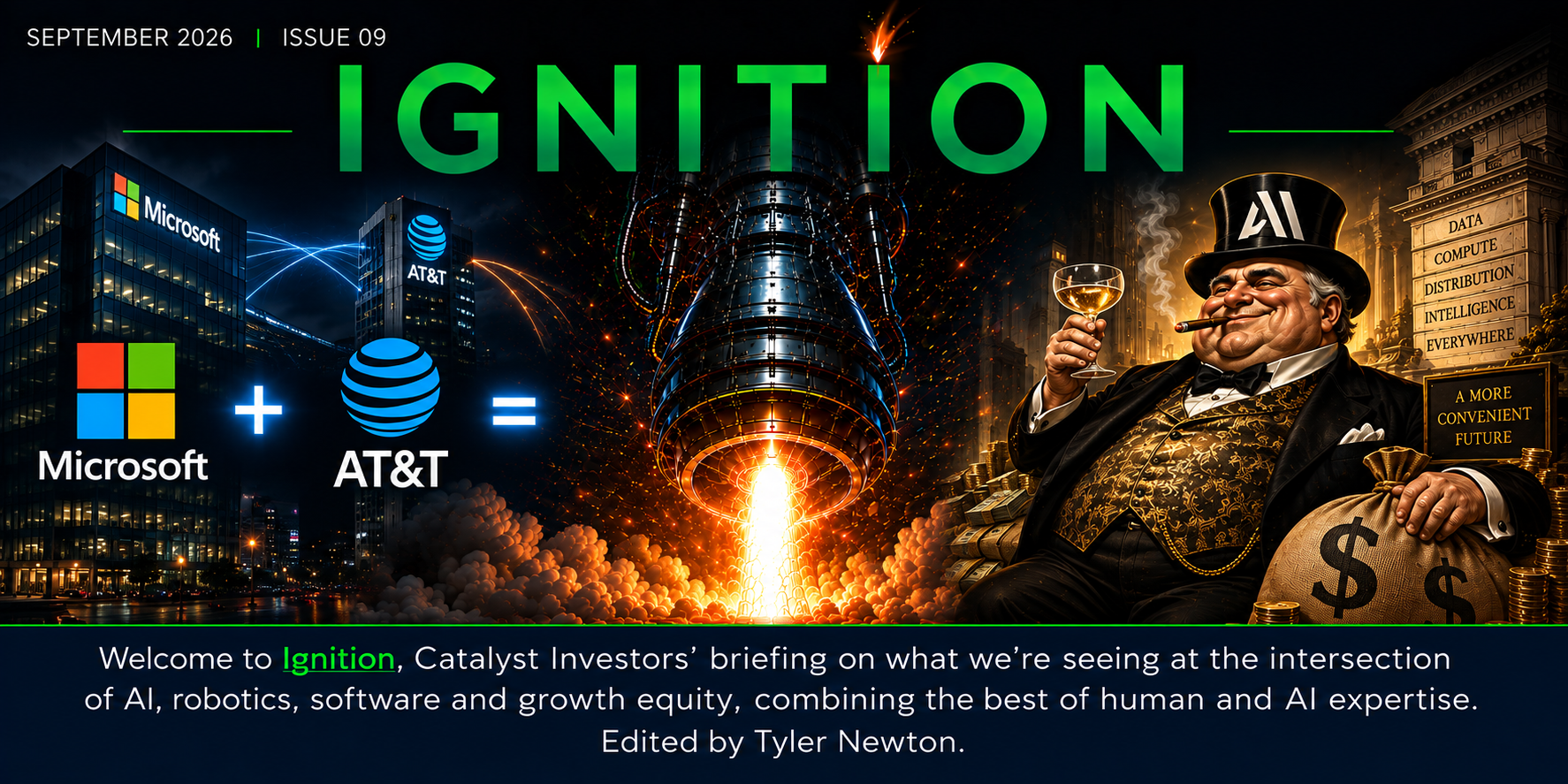
The regulated frontier will not stay at the model layer. A company with a protected platform monopoly at the model layer extends into applications, agents and robotics whenever a niche proves lucrative, and nothing underneath it can undercut on price. Microsoft did exactly this from the operating system into the application suite, on the strength of a platform monopoly alone. Add a federal charter and embedded supervisors and you have something closer to AT&T: a company permitted to be enormous because it has been designated too important to be left alone.
What It Means for Investors (Directionally)
Positive for Anthropic and OpenAI, and by extension Google and xAI, which own frontier models of their own. Neutral for the hyperscalers, who host whoever wins.
Negative for semiconductors and equipment. Nvidia takes it twice, once on capex and again because its Nemotron and Hugging Face strategy is a bet on open weights that a crackdown would strand.
One caution on the capex call. Infrastructure spending will eventually decelerate regardless. At a 2.6% run-rate yield (run rate model layer compute spend vs. cumulative infrastructure investment) against a 10% to 14% hurdle (assumed infrastructure depreciation), the return only comes back into line if capex slows, and the same slowdown collapses supplier earnings. Regulation is an accelerant here, and a convenient explanation, not a cause. The operating leverage in these chip providers is huge, both ways. SK Hynix swung forty margin points on an ordinary pullback in 2023, and the potential downward move now would be larger than that.
Negative for the application layer. Open weights were never protection from model-layer competition. They were the outside option, and the outside option allowed for software-like profit margins without running on top of a potential competitor who can squeeze you on price. Take the open weight option away and the threat does not change. The leverage does.
Negative for Chinese AI, at least on capability. If distillation is the core input and the input is cut off, the trajectory bends and Chinese models will fall behind. Sacks’s counterpoint is also valid: suppressing American open weights does not suppress Chinese ones, and a world with no US open layer is a world where every developer who needs downloadable weights uses Qwen. Both can be true. Chinese capability falls while Chinese share of the open weight ecosystem rises.
The Catalyst Take
AT&T held its charter for forty years. The public interest rationale was real, the service was genuinely universal, and almost nobody noticed what had not been invented until the breakup made it obvious.
The frontier labs are asking for the same arrangement, sincerely, for reasons they believe are urgent. They may even be right about the danger. But a regulated oligopoly at the model layer moves margin and power away from the companies building on top of AI and toward the handful of firms permitted to build it. That is good for four balance sheets and bad for a competitive economy. AI run amok is not the only risk we face.
Sources: Anthropic (September 12, 2026), OpenAI / Jakub Pachocki (September 6, 2026), NSA/CISA/FBI Joint Advisory AA26-251A (September 8, 2026), The Information (August 6, 2026), Wall Street Journal via 24/7 Wall St. (August 26, 2026), Gallup (March 2026), NBC News Decision Desk (September 2026), Catalyst Investors internal research.
Disclosure: Opinions as of the publication date and not investment advice; Catalyst Investors and its personnel may hold positions in the companies discussed, and no company mentioned paid for or reviewed this material.
Forward to a founder, operator, or investor who is navigating AI adoption.
ir@catalyst.com
261 5th Ave
Suite 1102
New York NY 10016