




In this issue:
- Sector rotation within AI has let air out before a bubble could form
- Anthropic and OpenAI to tap the equity market
- The frontier labs price below high-growth software comps
01 — THE SIGNAL
The Rolling Bull
Think of a highway under construction. Widen one lane and the jam does not disappear. It moves to the next choke point. The AI buildout has behaved the same way. Each time the market decided one constraint was solved, it went looking for the next one.
First the constraint was GPUs, and Nvidia led. Its trailing six-month return peaked at +150% in June 2024. Then the constraint was custom silicon, and Broadcom took over, peaking at +97% in September 2025. Memory came next. Micron’s six-month gain reached +311% in May 2026, the largest of the four. By June the trade had reached CPUs, and AMD’s six-month gain peaked at +171%.
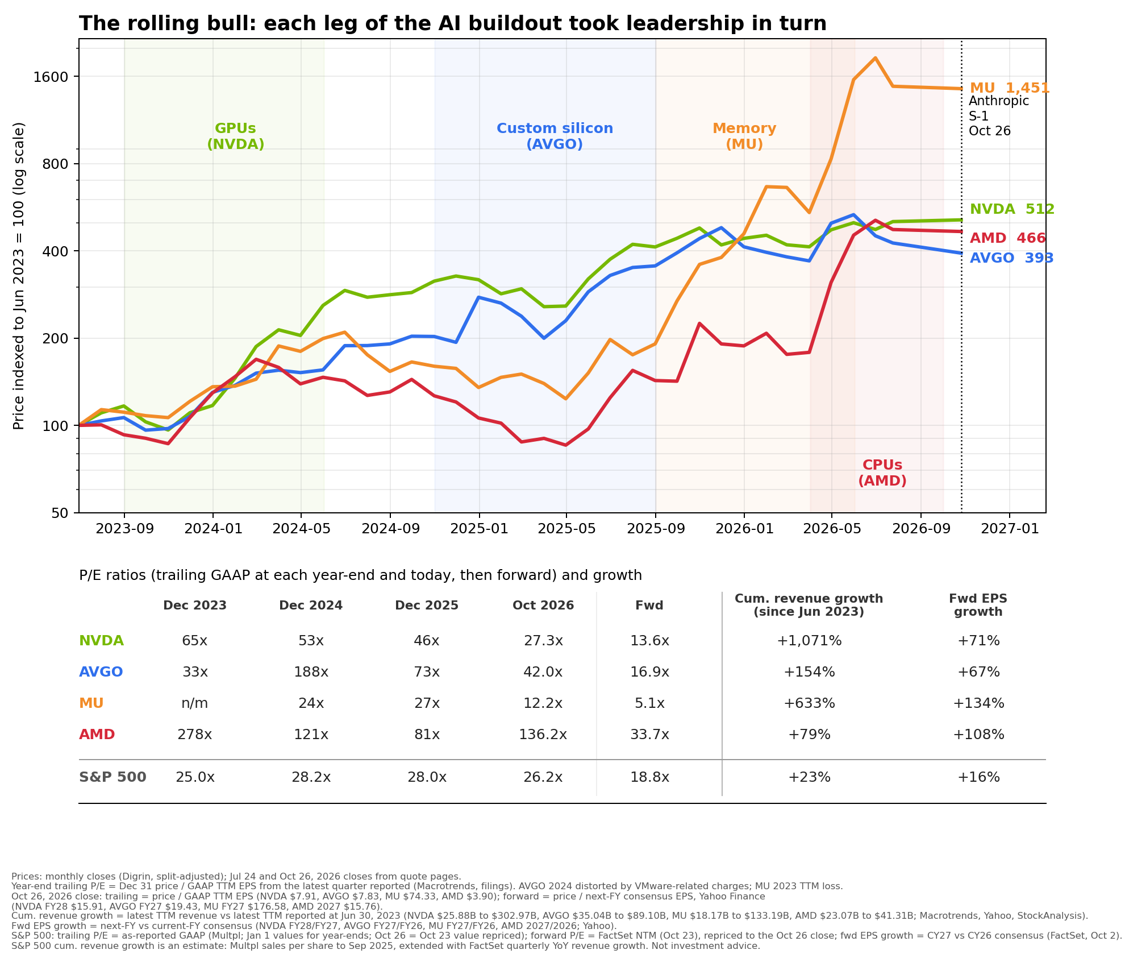
Three features of the chart matter.
First, leadership rotated rather than broadened. Market commentators (us included) have been using past analogies like the Dot Com bubble to pattern match with the AI buildout. A true market mania like we had during the Dot Com era of the late 1990s lifts everything at once. This did not. Each leg ran hard, stalled and handed off to the next leadership group.
Second, every leg took real damage on the way up. On month-end closes, the worst peak-to-trough declines were 22% for Nvidia, 28% for Broadcom, 41% for Micron and 49% for AMD. Today all four sit below their intramonth highs: Nvidia by 11%, AMD by 19%, Micron by 28% and Broadcom by 33%. Resets like these act as pressure valves. They let air out of the potential bubble along the way.
Third, the multiples did not run away. Nvidia’s trailing P/E fell from 65x at the end of 2023 to 27x. Micron’s fell from 27x at the end of 2025 to 12x. Broadcom (42x) and AMD (136x) still screen high on trailing earnings, but both drop sharply on forward estimates. Revenue explains why. Since mid-2023, trailing revenue is up 1,071% at Nvidia and 633% at Micron, so earnings outran the stock. The table under the chart shows the full set of numbers.
The market also had the warning label in hand. The Cisco comparison has circulated since the first Nvidia blowout, and investors have priced these stocks with it in mind.
A Boom, Not (Yet) a Bubble
Over on his Substack, Catalyst’s Tyler Newton asks the question: is AI in a bubble? He uses the framework from Charles Kindleberger’s Manias, Panics, and Crashes as a test. A mania moves through five stages: displacement, credit expansion, euphoria, distress, and panic. Score AI against the Dot Com and housing episodes and the picture becomes clear.
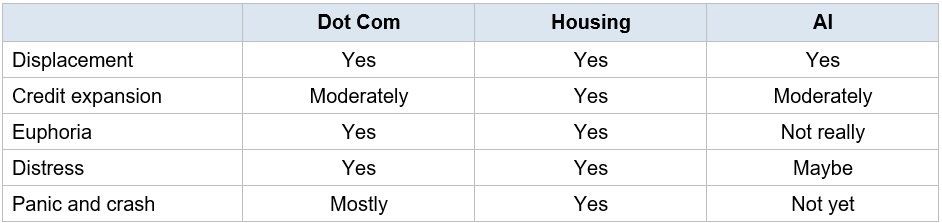
AI clears the first stage easily. ChatGPT was the displacement. Credit has helped, but most of the money comes from the cash flows of Amazon, Microsoft, Google, Meta, Nvidia and Broadcom, and the debt that exists is mostly backed by investment grade lessees. Last week’s neocloud squeeze fits that picture. CoreWeave’s stock fell about 36% in October, and its bonds now yield close to 16%. It’s a pressure valve release in a market that is still trying to maintain discipline.
The euphoria stage is where AI fails the test. In 1999 and 2006 the public was “all in” on the trade. Today it is skeptical, IPO activity is thin, and the multiples are modest. Nvidia trades at 13.6x forward earnings, Broadcom at 16.9x and Micron at 5.1x, against 18.8x for the S&P 500. AMD, at 33.7x, is the exception, but that’s against 108% forward earnings growth. These stocks rose because earnings rose, not because investors bid up the multiple.
Concentration is the one statistic that does look like a mania. The top 15 stocks are 47% of the S&P 500’s market value, nearly double the Dot Com peak. But AI and technology generated 70% to 80% of last year’s earnings growth. The market is concentrated where the profits are.
Two warnings. Memory multiples are lowest at peak earnings, which is how cyclicals look just before they turn. And as we’ve discussed before, as the hyperscalers spend, they depreciate the cost over many years, and the chip companies and other suppliers book the spending as revenue day one while pushing up margins. It has been a structural earnings bonanza that will turn hard after capex spending peaks.
That leaves the question of who ultimately pays. Frontier model companies Anthropic and OpenAI take up about half of committed forward compute capacity and both are tapping the equity markets and preparing to take the market leadership baton from the semiconductor companies.
02 — MARKET MOVERS
The Anthropic S-1
For three years investors have had the financials of the sellers of AI compute and almost none from the two biggest buyers. The Anthropic S-1 changes that. It is the first look at the demand the whole rolling bull has been selling into, and it holds up better than the skeptics expected.
Start with growth. Revenue in the first half of 2026 was $16.3 billion, against $1.2 billion a year earlier. Q3 revenue was reportedly $16.8 billion, up 45% from Q2, which annualizes to about $67 billion. Newton’s Substack post estimates that each lab needs roughly $500 billion of revenue to justify the compute being built for it. From $67 billion, that is a 7.5x increase, after a 14x increase over the past year.
The economics are better than the headline loss suggests. The $80.7 billion net loss is mostly noncash accounting on convertible instruments. The operating loss for the half was $693 million, narrowed from $2.1 billion, and Q2 produced the first operating profit, $974 million. Operating cash flow was positive at $3.9 billion, and cash and securities stood at $131.7 billion.
The unit economics are the real story. Cost of revenue implies an 85% gross margin on inference. Compute and infrastructure fell from 201% of revenue a year ago to 55%. The customer base is broad. There are more than 11,900 customers above $100,000 and about 250 above $10 million. Five customers made up nearly a quarter of 2025 revenue, and none exceeded 10%.
None of this makes the IPO risk-free. Three facts stand out.
- Commitments dwarf the cash. Compute obligations reportedly now run $540 billion or more, against $131.7 billion of cash. Revenue growth must close that gap.
- Usage is the product. 80% of revenue is consumption revenue, and consumption can fall as fast as it rises. The remaining 20%, subscriptions, runs on short-term contracts.
- Control stays with the founders, reportedly through a single Class F share that carries a majority of the votes.
Then there is price. The last private mark was about $965 billion in May. The reported IPO range is $1.5 trillion to $2 trillion, a step-up of 1.6x to 2.1x in five months.
Anthropic has filed to trade on the Nasdaq with the ticker symbol “ANT.” The S-1 makes the handoff plausible. It does not make it free.
OpenAI’s Round
The Anthropic IPO is not the only test this month. OpenAI is raising about $30 billion privately at the same time, and the market will compare the two events whether anyone intends it or not.
The terms have already moved. Bloomberg reports the target valuation slipped from $1.4 trillion to $1.25 trillion during final negotiations. Reports say Coatue and a UAE sovereign fund are leading the round, with investors expected to decide by Oct 30. These are outside financial investors. The previous round, in March, raised $122 billion at $852 billion post-money, anchored by SoftBank, Amazon and Nvidia, all strategic partners or suppliers. Secondary-market marks sit around $1.1 trillion to $1.2 trillion, so $1.25 trillion is a modest premium to where shares trade, not a discount.
The round is small for the company. Thirty billion on $1.25 trillion is about 2.3% dilution. It is a bridge to a 2027 IPO and a price mark, not a funding need.
Two things to watch.
Relative value. On $50 billion of run-rate revenue, $1.25 trillion is 25x. Anthropic at $1.5 to $2.0 trillion on about $67 billion is 22x to 30x. OpenAI is priced inside Anthropic’s range. If Anthropic prices well, OpenAI’s round will look reasonable in hindsight. If it prices poorly, OpenAI’s price will be the one exposed.
Valuation discipline. A cut of $150 billion in three weeks says buyers are price-sensitive, not euphoric.
The Valuations Are Reasonable
There is a second way to test the coming handoff. Compare the model companies against high-growth SaaS companies that have large addressable markets: Palantir, CrowdStrike, Cloudflare, Palo Alto Networks, Datadog and Snowflake.
One framing choice matters. Inference compute sits in cost of revenue, which gives Anthropic an 85% gross margin. Below that line, Anthropic’s operating costs are structurally different from a SaaS company’s, so GAAP operating margin is a fair way to cut through the noise.
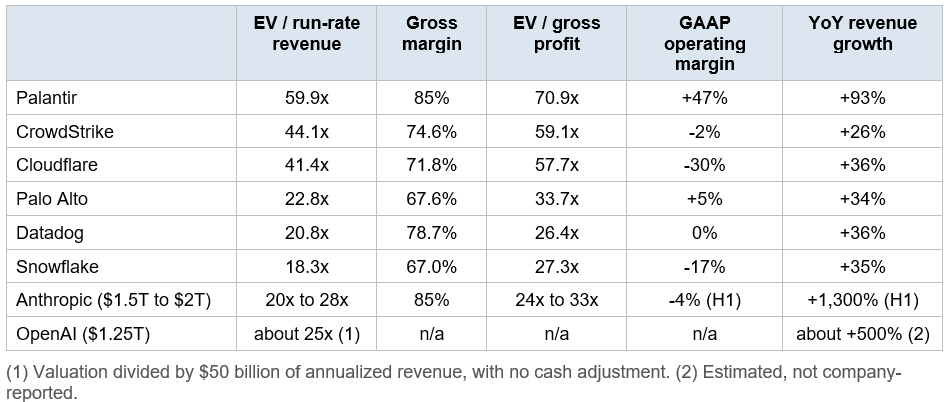
Run-rate revenue is the latest quarter times four. Four things stand out.
- The labs are valued below the median. The six comps run from 18x to 60x run-rate revenue, with a median of 32x. Anthropic is 20x to 28x and OpenAI about 25x.
- The comps split into two tiers. Snowflake, Datadog and Palo Alto sit at 18x to 23x, or 26x to 34x gross profit. Cloudflare, CrowdStrike and Palantir sit at 41x to 60x, or 58x to 71x gross profit. The labs are closer to the lower tier.
- The operating margins are comparable. Anthropic’s -4% for the half falls between Snowflake’s -17% and Palo Alto’s +5%, and it is far better than Cloudflare’s -30%. Q2 was the first quarter of GAAP operating profit.
- Growth is higher. Five of the comps grow 26% to 36% a year. Anthropic grew 45% from Q2 to Q3 alone. Anthropic’s +1,300% annual growth and OpenAI’s estimated +500% are far ahead of even Palantir’s +93%.
The comparison has limits.
- Training compute is less flexible than headcount-driven R&D. A software company can slow hiring. A lab with noncancellable commitments cannot.
- EV leaves out the $540 billion of forward compute commitments at Anthropic, which could be looked at as contingent debt. OpenAI’s compute commitments are reported to be greater than $750 billion.
- GAAP margins at the comps carry heavy non-cash stock compensation. Cloudflare’s GAAP operating margin is -30% against +14% non-GAAP.
Conclusion
For now, the handoff can be made.
The infrastructure trade has done its job. It rotated through every bottleneck, from GPUs to custom silicon to memory to CPUs, with explosive earnings, not valuation multiples, doing most of the work. The next test belongs to the model layer. The S-1 shows Anthropic revenue on track to carry the commitments built on its behalf, if growth holds. The valuation sits below the median of the software comps. That gives the Anthropic IPO a reasonable chance of success. OpenAI will likely get its round done near $1.25 trillion, with enough outside money to show the demand is not just recycled vendor money.
If both deals are successful, the AI bull should be able to roll on into 2027.
What would break it is a shrunken OpenAI round at a lower valuation, a weak Anthropic debut, or another credit squeeze in the neoclouds that spreads to bigger names like Oracle and Meta. Any one of the three would move distress from “maybe” to “yes” on the scorecard. The next big test will be the OpenAI IPO attempt in H1 2027. There are still plenty of financial hurdles that could trip up the bull.
Disclosure: Claude, an AI model made by Anthropic, assisted with research and editing. Anthropic is a subject of this issue, including the S-1 and valuation sections. This newsletter is not investment advice.
Forward to a founder, operator, or investor who is navigating AI adoption.
ir@catalyst.com
261 5th Ave
Suite 1102
New York NY 10016