




In this issue:
- OpenAI clarifies its revenue
- Anthropic reports Q3
- CoreWeave strains the AI trade
01 — THE SIGNAL
The Numbers at the End of the Chain
Both frontier labs disclosed run-rate revenue in the past eight days. Two IPOs will price off those figures, and so, indirectly, will about $2.2 trillion of infrastructure spending. The S&P 500 and nearly $600 billion of corporate debt are highly dependent on the financial fortunes of these two currently private companies.
Where our thesis stands
- Roughly $2.2 trillion of cumulative AI infrastructure investment, 2024 through 2026, on raised capex guidance.
- Roughly $225 billion of run-rate AI revenue across the frontier labs and the application layer, after stripping out the API fees the application layer pays the labs.
- About $97 billion of that reaches the infrastructure layer as compute spend. Almost all of it is bought by the labs. Direct purchasing by application companies has increased, but it still rounds to a few billion, because the application layer is asset-light by design.
- That is a yield of about 4.4%, against the 10% to 14% required to cover depreciation alone. Better than the 2.6% we calculated in Issue #6 (updated here for more recent growth estimates), but still less than half of what is needed.
- OpenAI’s $1.15 trillion and Anthropic’s $518 billion of forward commitments are the collateral underneath the buildout.
- As discussed in Issue #4, the “open weight squeeze” caps what either can charge, potentially putting their ultimate valuations at risk.
The $20 Billion That Wasn’t
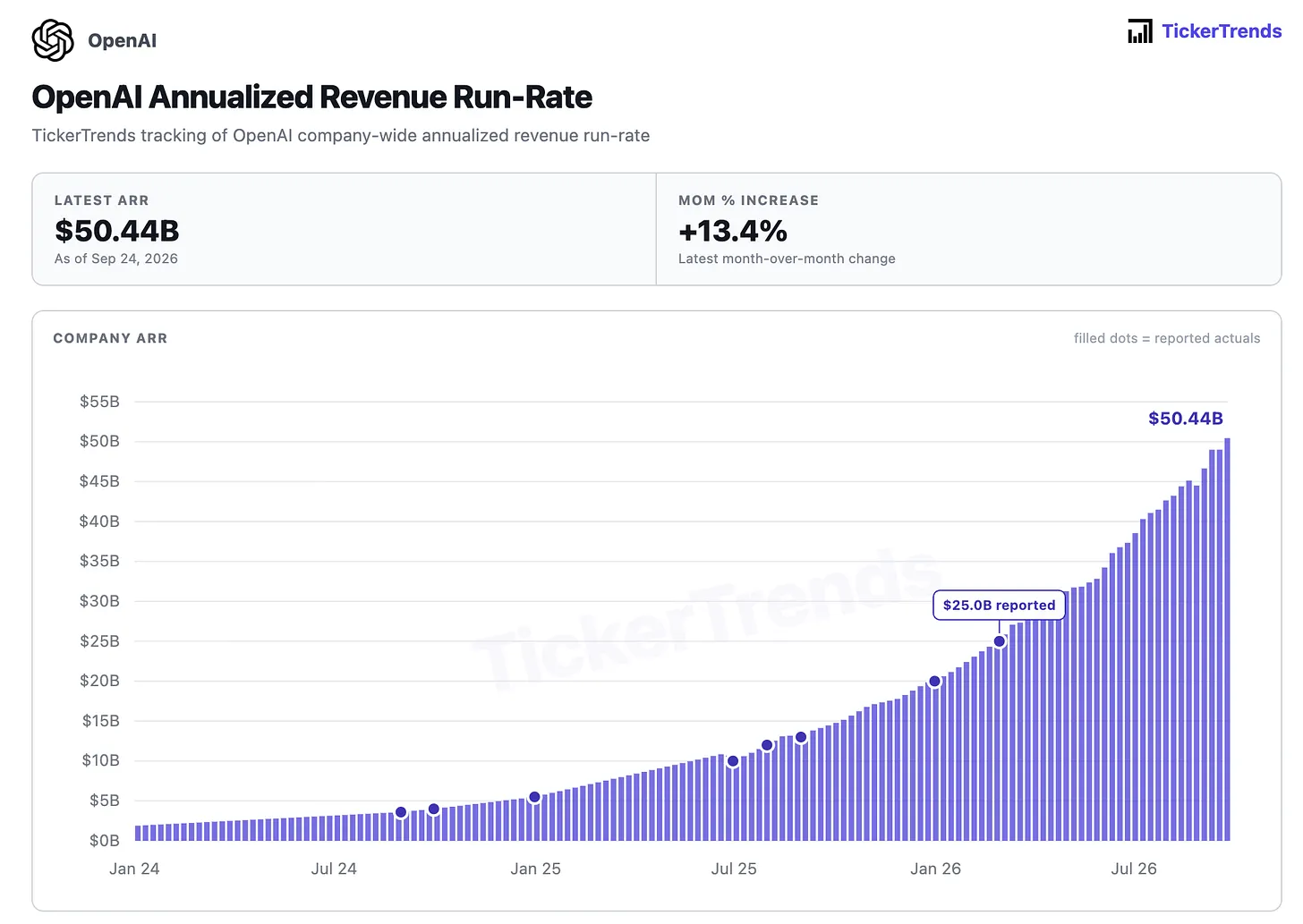
The Financial Times reported on October 8 that OpenAI had told investors its annualized revenue was approaching $50 billion at the end of September. The figure circulating a week earlier was $70 billion. AI stocks sold off on the gap.
The $70 billion was never an OpenAI disclosure. Investors had grossed up an August base of about $40 billion to make it comparable to Anthropic’s accounting treatment, then applied OpenAI’s reported 70% growth to the grossed-up number.
The underlying difference is ASC 606, principal versus agent. Anthropic books the full value of sales made through cloud providers. OpenAI books only its own share of partner sales. Both are compliant. Neither is comparable to the other.
Bloomberg reported the following day that OpenAI still expects $70 billion or more by year-end, while raising $30 billion at a $1.4 trillion valuation. According to TickerTrends, OpenAI has had a steady growth rate over the past three years:
Anthropic’s Quarter
Anthropic told investors on October 14 that third-quarter revenue was $16.8 billion, following $4.7 billion in Q1 and $11.6 billion in Q2. That annualizes to $67.2 billion. The company said it was profitable on an adjusted basis and cash-flow positive. “Adjusted” is undefined, and Anthropic has not said what sits below the line. Training compute is the obvious candidate.
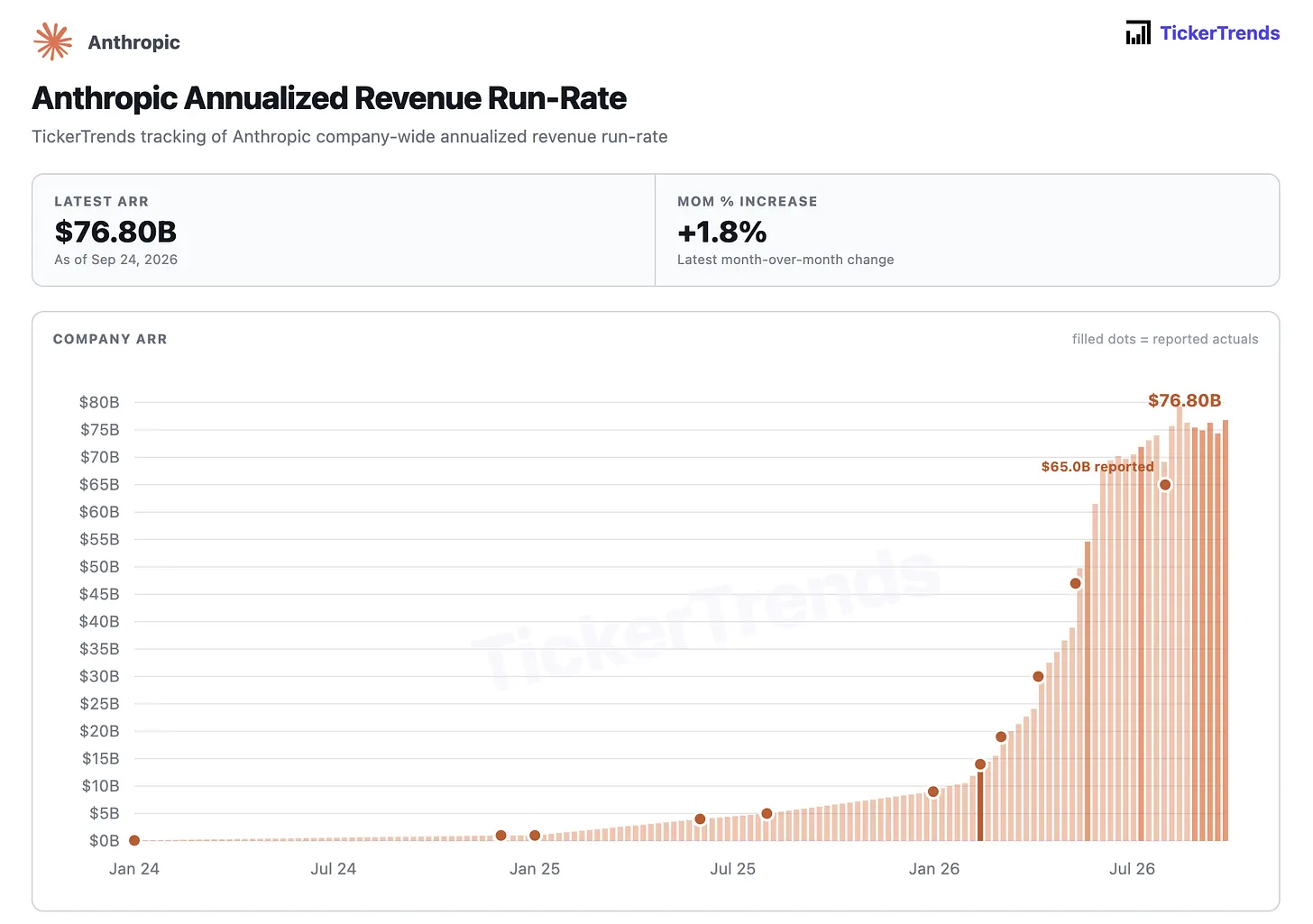
The ramp is extraordinary, but it is decelerating. Q1 to Q2 was 147%. Q2 to Q3 was 45%. Before the investor day, Jefferies wrote that investors expected $80 billion annualized for Q3 and $105 billion annualized by year-end. That year-end number now seems highly optimistic.
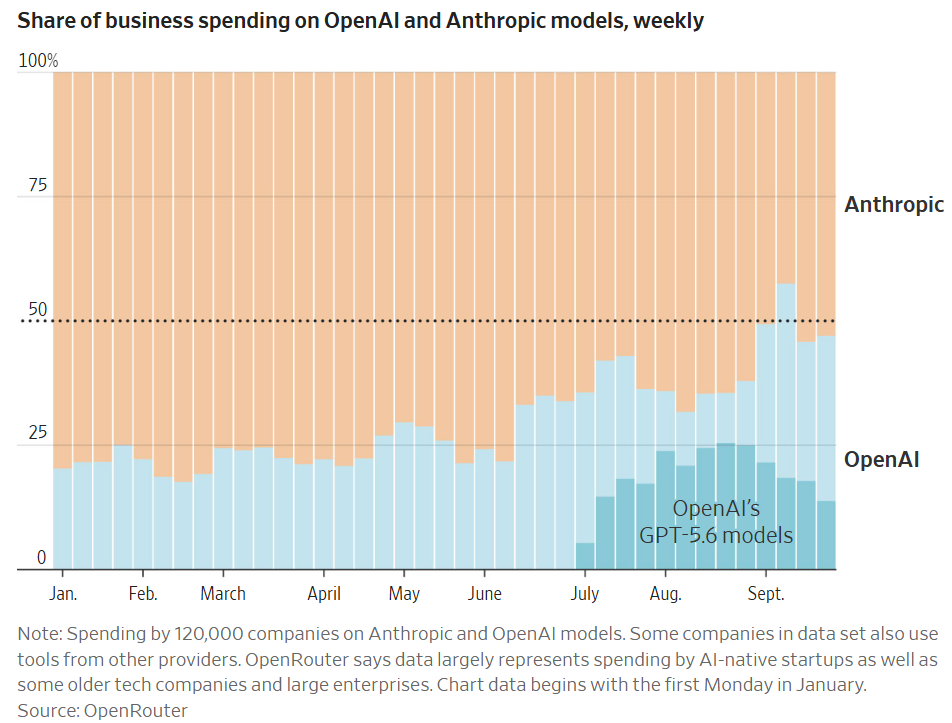
Business spending tells the same story from the other side. In September, 43.8% of Ramp businesses paid Anthropic, up a quarter point. OpenAI rose 1.12 points to 40.6%, the first month it has materially out-added Anthropic. Our read is that Anthropic built its lead on Claude Code in Q2 and that OpenAI’s Codex closed much of the gap in Q3. This is consistent with the OpenRouter data:
Why Both Numbers Matter
Grossed up to Anthropic’s accounting, OpenAI’s roughly $50 billion lands near Anthropic’s $67 billion, so the two are effectively tied. Anthropic is reportedly targeting a $2 trillion valuation in a 2026 IPO. Given the revenue slowdown, that valuation feels a bit rich, to say the least.
These two revenue lines are also the most important demand-side justification for the entire infrastructure buildout, and they are what the AI debt market ultimately writes against.
The question of the week was whether OpenAI is growing steadily or Anthropic is slowing. The better question is whether the numbers at the end of the chain are load-bearing enough to support the IPOs that will fund their giant spending commitments.
02 — MARKET MOVERS
Pulling the Leverage Chain Tight
At the annual dinner last month, we described a daisy chain of leverage running from the frontier labs through the hyperscalers to private credit and into the life insurance industry. Three weeks later the chain got pulled tighter.
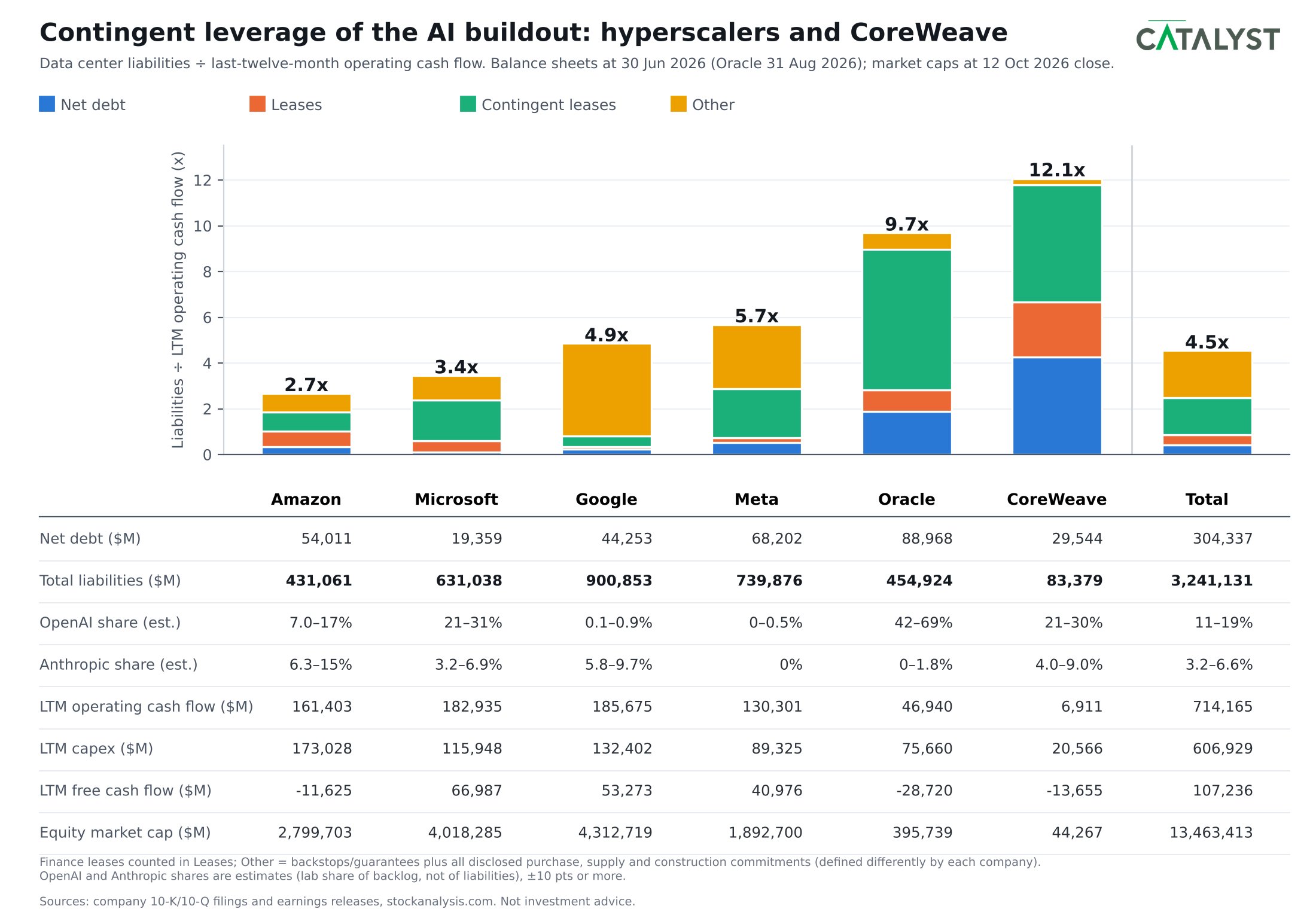
The following chart maps the debt and infrastructure spending commitments of five public hyperscalers and the “neocloud” CoreWeave against their LTM operating cash flow. The commitments include leases, signed but not commenced leases and other firm commitments that back data center financing.
Worth noting:
- Google is at 4.9 times LTM operating cash flow. Meta at 5.7. Oracle at 9.7. CoreWeave at 12.1.
- Ares counts $573 billion of SPV private credit and investment-grade financings in the last twelve months. By our count, more than 70% of that is effectively backed by Meta, Oracle, OpenAI or Anthropic.
- That private credit sits largely on life insurer balance sheets, levered on average twelve times assets to equity.
- We covered Oracle’s weaknesses in Issue #10.
The First Link to Creak
Most exposed of the six is CoreWeave. On October 14, worries about CoreWeave went viral.
- Five-year credit default swaps went from 368 basis points on October 6 to above 1,000 within the week, touching a record 1,194.5 intraday. Above 1,000 is generally read as distress. The market is pricing better than 60% odds of default within five years.
- The 2031 bond yields hit 15.78%. The 2032 unsecured notes trade below 80 cents.
- It spread. Oracle’s five-year CDS hit a record 288 basis points and SoftBank’s 424. Nebius stock fell 11%, Oracle 9%, Nvidia 2%.
Ares makes the structural point better than the headline number does: most of the dollars financing this buildout will capitalize silicon, the fastest depreciating asset in the stack, with the lowest recovery value in a downturn, in a financing market with the shortest track record. We argued a version of this about GPU residual values in Issue #7.
The Counterpoint
Oracle and CoreWeave both point to their backlog, and the arithmetic is on their side. CoreWeave has $104 billion of contracts against $83 billion of debt and obligations. Oracle’s remaining performance obligations reached $664 billion in August, and it expects half of that to convert to revenue within three years. Its spending commitments are $455 billion.
This math works only if the backlog converts to cash. Roughly half of Oracle’s RPO is OpenAI, and CoreWeave carries about $22.4 billion of OpenAI contracts. OpenAI is the one link in the chain with (a) no non-AI profit pool, (b) forward commitments at roughly 23 times net run-rate revenue, (c) an operating loss larger than its revenue, and (d) an IPO postponed to 2027. A backlog that exceeds your liabilities is reassuring only if the counterparty is good for it.
The Catalyst Take
Jensen Huang said in Stockholm on October 15 that CoreWeave’s strength is improving every day, that its cost of capital is decreasing, and that no backstop is needed. He said it on the day the credit market priced default at better than a coin flip.
Nvidia owns about 10% of CoreWeave and already discloses $105 billion of lease guarantees for OpenAI in its own 10-Q. CoreWeave’s most bullish analyst, Tal Liani of Bank of America, published a $140 target the same morning and noted that everyone with a vested interest in the buildout will offer comforting words, including Jensen. “No backstop needed” is a statement about willingness, not capacity.
The leverage chain is pulled tight, with several creaking links, wrapped around a circular financing gear called Nvidia. Hopefully the chain, and the gear, continue to hold.
Sources: Financial Times (October 8, 2026), Reuters and CNBC (October 14 and 15, 2026), Bloomberg (October 9, 2026), Ramp AI Index (October 14, 2026), The Information, Wall Street Journal, Catalyst Investors internal research. CNBC and Bloomberg (October 15, 2026), ICE Data Services, S&P Global Market Intelligence, Ares In the Gaps: The Hangover, Nvidia Form 10-Q (July 26, 2026), Oracle Form 10-Q (August 31, 2026), CoreWeave filings, Yahoo Finance / Brian Sozzi (October 15, 2026), Catalyst Investors internal research.
Forward to a founder, operator, or investor who is navigating AI adoption.
ir@catalyst.com
261 5th Ave
Suite 1102
New York NY 10016