In this issue:
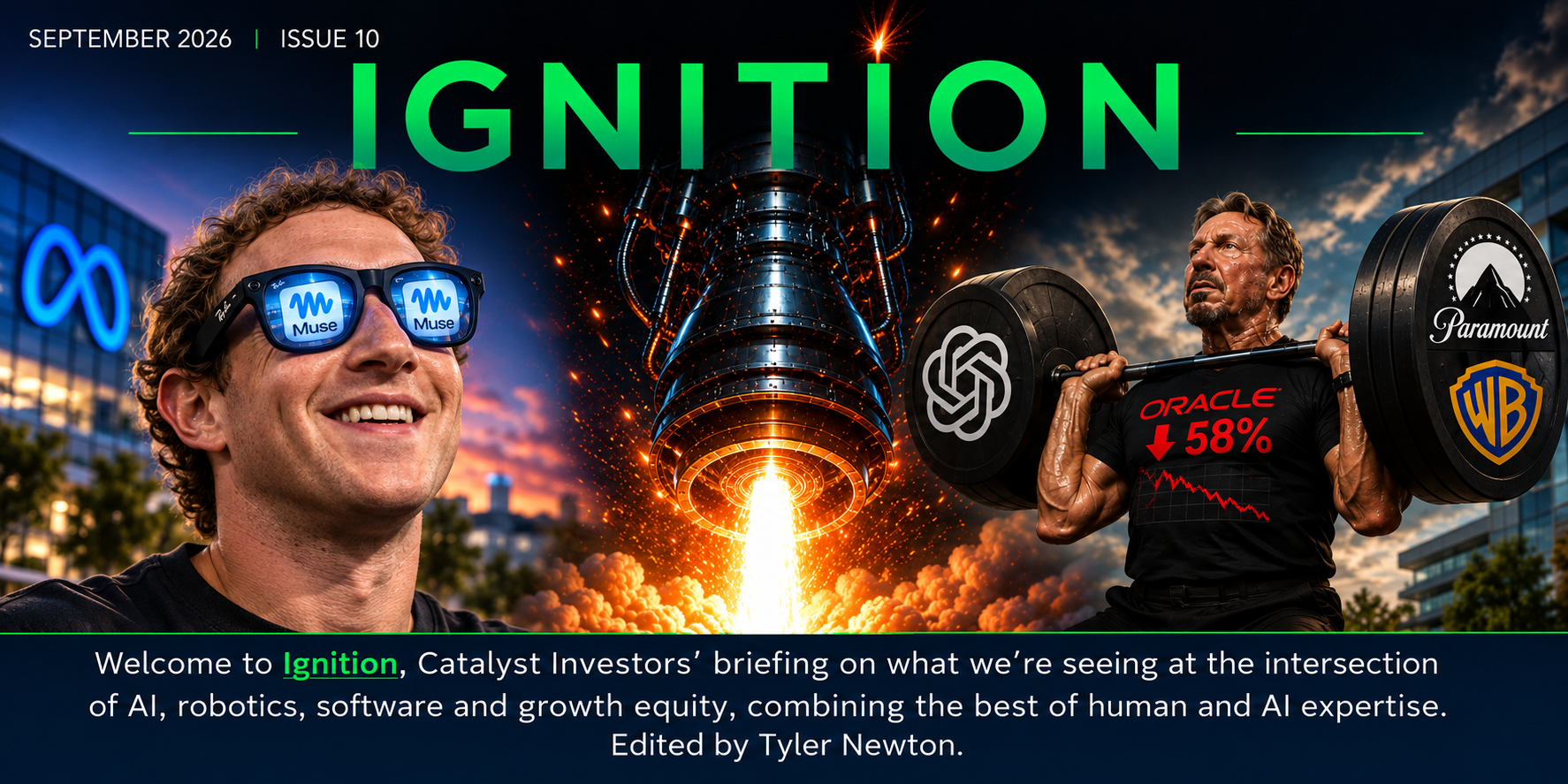
- Meta has a hit with the Muse personal agent…
- …but Amazon blocks it
- Oracle’s stock is carrying a heavy load
01 — THE SIGNAL
Meta (Finally) Has an AI Strategy
For three years Meta’s AI program has been enormous, but opaque.
Capital spending went from $37 billion in 2024 to $70 billion in 2025, and April’s guidance for 2026 was raised to between $125 and $145 billion. In June 2025 Meta paid $14.3 billion for 49 percent of Scale AI, a deal that brought over Scale’s chief executive, and it was reportedly offering a number of individual researchers nine-figure pay packages. What nobody could say was what this spending would produce.
Meta’s model strategy did not help. From 2023 Meta published its models free to download and argued publicly that open weights was the right path. That earned 1.2 billion downloads and no revenue. Then the April 2025 flagship model received a lukewarm reception, and its successor was previewed and never shipped. A year later the Scale team’s first model was closed, with no successor to the open models on the roadmap. In July Meta allowed outside developers access to the closed model as a paid service, its first ever, at roughly a third of what the frontier labs charge. Free, then closed, then discounted.
Meanwhile the only thing a customer could actually buy was a pair of glasses, and those worked. EssilorLuxottica reported more than seven million smart glasses sold in 2025, triple the prior year. But the embedded camera made them a running privacy fight over recording bystanders. Meta’s answer this month was camera-free Ray-Ban Meta Audio glasses starting at $349.
Seven million units of a controversial accessory, against roughly $250 billion of cumulative capital spending through YE 2026. That was the scoreboard three weeks ago.
Enter Muse
On September 8 Meta shipped the Muse personal agent. It books travel, sends email, fills out forms, lowers bills, turns a recipe video into a grocery order, and checks out with a card. Free to start, then $20 or $100 a month. Muse had 730,000 downloads in five days and 2.5 million in thirteen, passing ChatGPT to become the top free iOS app in the United States. Meta stock rose 6.5 percent the day after launch and has gone up more than 25 percent since. At its Connect event on September 23 the company previewed Muse Charm, a keychain-sized device that ships in December and whose only job is talking to the agent. Meta said Muse will become the primary interface for the glasses.
In hindsight Meta’s strategy makes more sense. The models were the engine and the glasses a way in. Meta could not explain it until it had the agent that ties the two together.
Meta has moved fast on merchants: Stripe’s Link at launch, covering more than a million businesses, Shop Pay announced across Shopify stores, PayPal last week, and direct connections to Walmart, Best Buy, Sephora and Wayfair. Yet Amazon blocked Muse within two weeks. Amazon’s stated objection is disclosure and safety, but its own competing shopping tools do the same job. Plus, agents don’t look at ads.
The bull and bear cases on Muse
The bull case on Muse is reach. Meta has 3.6 billion daily users, a launch that took the top spot on the App Store inside a week, a merchant coalition that includes Walmart, Shopify, Stripe and PayPal, and a hardware line that already sells seven million units a year and now has the agent designed into it. If agents become the default way people transact, Meta starts from a distribution position nobody else can assemble.
The bear case is that downloads measure curiosity, not engagement, and there is no retention data yet. Muse has plenty of competition. Agent startup Instinct is reportedly in talks at a $10 billion valuation with a product still in invite-only testing, and Google, OpenAI and Amazon are all shipping agents of their own. And Amazon, the largest online retailer and logistics operator in the country, has shut Muse out entirely.
Meta cut a key designed to fit every lock. Amazon demonstrated that controlling the lock is valuable.
02 — MARKET MOVERS
Oracle’s Load-Bearing Stock Price
On September 24 Oracle sent a force majeure notice to a Blue Owl Capital unit, the developer of Project Jupiter, the 2.45-gigawatt Stargate data center campus in Doña Ana County, New Mexico. The cause is specific and local. The site was engineered around gas fuel cells fed by an Energy Transfer pipeline, but the state land office has rejected the proposed route more than once. The in-service date has slipped roughly six months, and a state air-quality decision is due before November 23. Securing power is Oracle’s obligation under the contract, and the lease reportedly cannot be terminated.
So, this is not an exit. It extends the period during which Oracle pays the lower development-stage rent, and it opens a negotiation. Oracle says it is fully committed to New Mexico. Read the notice as a company looking for cost relief where the contract gives it an opening.
One notice is not a credit event. It is worth noticing anyway, because of the balance sheet underneath it. Oracle closed fiscal 2026 with $638 billion of contracted cloud commitments against $138 billion a year earlier, close to half of which is reportedly from OpenAI, and expects roughly 12 percent to convert to revenue this year. Capital spending went from $21 billion to $56 billion in a single fiscal year, funded with $43 billion of new senior notes in nine months on top of roughly $100 billion of existing debt. CLSA estimates Oracle could need up to $500 billion of capital through 2030, with internal cash generation covering only about a fifth of that. A company carrying that load, hunting for relief on development rent, is a company feeling the squeeze.
Oracle sits in the middle of three parties. Oracle is the data center tenant, and it owes rent to the owner Blue Owl whether or not the site gets power. Oracle’s signature is what got the developers roughly $18 billion in bank loans. OpenAI, whose own financing is unsettled, is Oracle’s customer under a reported five-year contract for about 4.5 gigawatts. Oracle is on the hook for the lease and the buildout while exposed to the credit risk of a money-losing customer.
In addition, Larry Ellison has pledged roughly 36 percent of his Oracle stake, worth about $57 billion at Friday’s close, to secure personal loans. Much of this borrowing supported his son’s purchase of Paramount and then $40.4 billion of the equity financing for Paramount Skydance’s $111 billion bid for Warner Bros. Discovery. This equity will sit behind about $77 billion of debt at the combined entity. Oracle’s board says none of those shares sit in margin accounts and that he can repay without selling.
Big promises, one share price. That price set its record the day the OpenAI contract became public and has fallen roughly 58 percent since, hitting a fresh 52-week low this week.
The Catalyst Take
Do not read the force majeure as the AI credit cycle turning (yet). It is narrow and probably tactical. Do read it as a company economizing where it can, which is worth watching from a business CLSA estimates could need up to $500 billion of capital spending over the next four years. Oracle’s share price is the load-bearing wall holding up both the Stargate buildout and the founder’s borrowing. A load-bearing wall built on a shaky foundation of OpenAI spending commitments while holding up a highly leveraged old media company is not one I’d want to write protection on.
Sources: Sensor Tower via CNBC (September 21, 2026), TechCrunch (September 8, 2026), GeekWire (September 2026), Reuters coverage of Meta Connect (September 23, 2026), EssilorLuxottica FY2025 annual report, Meta Q1 2026 earnings. Bloomberg and Reuters (September 24, 2026), Axios (September 25, 2026), Oracle FY2026 Form 10-K, Oracle proxy statement (September 25, 2026), Wall Street Journal reporting on lease terms.
Forward to a founder, operator, or investor who is navigating AI adoption.
ir@catalyst.com
261 5th Ave
Suite 1102
New York NY 10016