


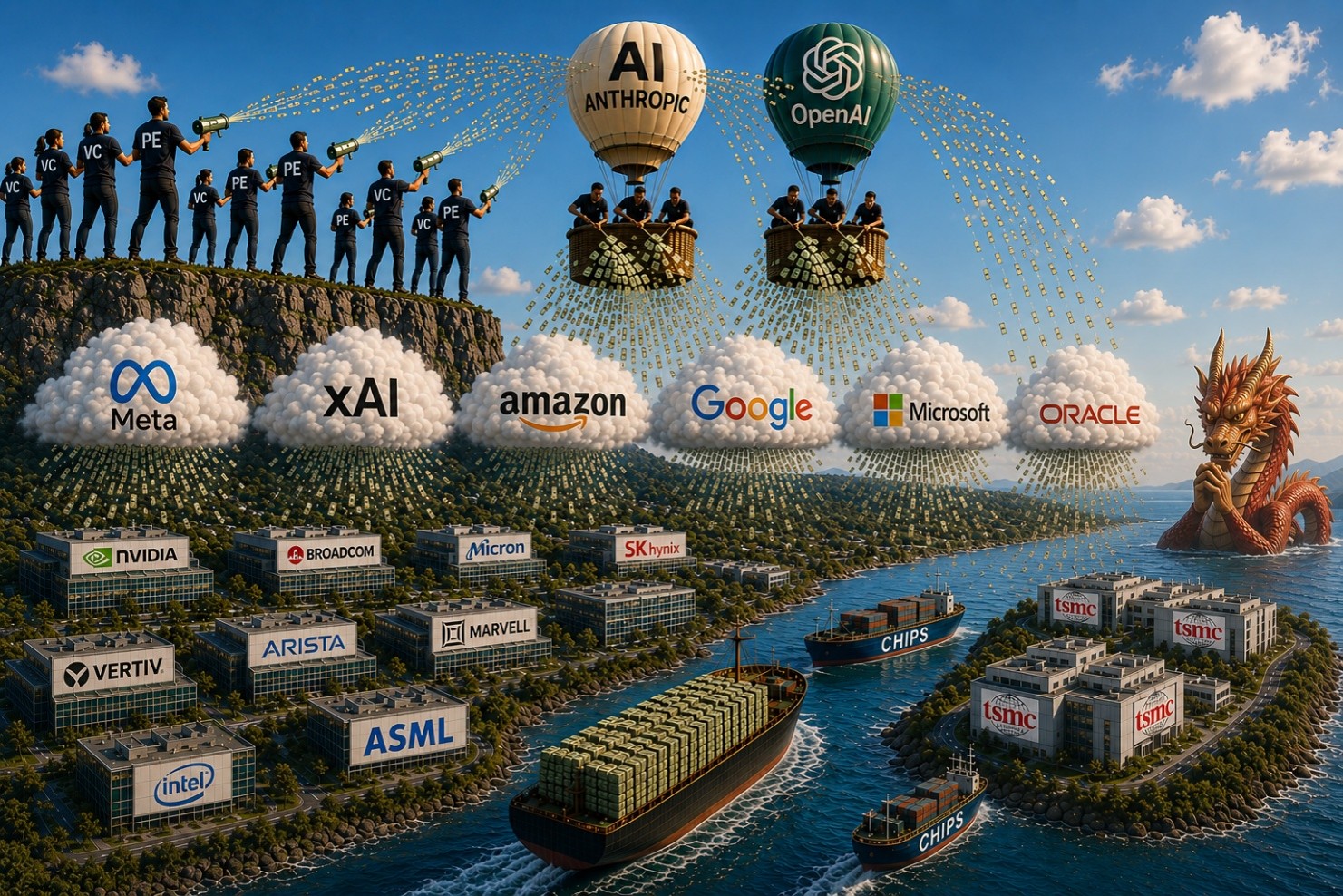
This article originally appeared in Tyler Newton’s Substack, The Dynamist, on 7/28/2026
The AI infrastructure buildout is the single largest capital allocation decision happening anywhere in the developed world right now. Combined hyperscaler AI capex went from roughly $235 billion in 2024 to $431 billion in 2025 to a guided $775 billion in 2026. That is not a typo. It is a number that has tripled in two years, and it is still guided to grow next year. When a spending program gets that large, the question is where the money goes once it leaves a hyperscaler’s balance sheet. So we built a full flow-of-funds map of the AI economy to answer it, tracing dollars from their original source, whether that is venture capital, corporate bonds, private credit, or actual product revenue, all the way down through the frontier labs, the hyperscalers, the neoclouds, and the physical supply chain that turns capital into compute.
The map

Dashed ovals mark layers with more than one company in them, so a ribbon landing on a dashed oval means money flowing to the layer generally, not to one named firm. Arrow width scales with the square root of the dollar figure, so it compresses the difference between a $22 billion contract and a $1.4 trillion one enough to fit on one page.
The layers
Funding sources sit at the top: consumer and enterprise revenue, VC and private capital, and the portion of hyperscalers’ own core-business profit and debt/equity issuance that gets redirected into AI capex.
That money flows down into the application layer and the frontier labs. The frontier labs (or more generally, the large language models, or “LLMs”) get revenue both directly from consumers and businesses and from API fees paid by the application layer. These are the recipients of actual AI revenue, whether in the form of subscription or usage fees.
The next layer is the hyperscalers and neoclouds. These are currently the main drivers of the AI infrastructure buildout. These firms are building the compute capacity that the LLMs use to create AI “tokens”, the standardized unit of AI output. The profitability of these investments will be a function of whether they can drive down the cost to produce tokens faster than the decline in the price of tokens sold to the LLMs. For the overall infrastructure investment amount, it will be driven by whether the growth in the demand in the volume of tokens outpaces the capital required to produce those tokens. That means the cash gross profit of selling tokens needs to exceed the depreciation on the accumulated investment in AI infrastructure.
Everything else is downstream from the capex decisions of the hyperscalers and neoclouds. We have the chipmakers, memory makers, chip foundries, and the semiconductor equipment makers who build the tools that make the chips. These companies’ revenues are a direct function of the nominal amount of hyperscaler capex.
Off to the side we also have the data center complex. Private debt and equity have funded the construction of data centers themselves, which is often separate from the money that funds the computing equipment within the data centers. Some data centers are owned by the hyperscalers, some are controlled by the hyperscalers but held in SPVs and some are standalone data center operators. Data center revenues are effectively real estate leases paid for by the hyperscalers and neoclouds. Some special purpose data centers are backed by guarantees or collateral from hyperscalers and chip makers. There are a number of companies that benefit directly from the construction of data centers like Vertiv, Arista Networks, GE Vernova, Eaton, Emerson Electric and Caterpillar with revenue tied to the nominal amount of data center construction spending.
We highlighted the most major nodes in the AI economy by making their boxes bigger: Anthropic and OpenAI (the two together are more than half of all actual AI revenue), Amazon, Google and Microsoft (the hyperscalers that host most of the compute), Nvidia (whose chips dominate the compute) and TSMC (whose fabs produce >90% of all AI chips).
Exogenous versus endogenous money
It is important to distinguish between money that is exogenous to the AI economy (the funding sources referenced above that come from outside the system) and endogenous money, which is money flowing between the layers within the AI economy. For example, the free cash flow produced by Google’s advertising business that is directed to building AI infrastructure is exogenous, while the money Google then spends on Nvidia chips and Micron storage and the money that Nvidia sends to TSMC to fab its chips is endogenous. Yes, there is also “circular financing”, such as the same dollars round-tripping between a hyperscaler and a lab it has invested in. Microsoft’s roughly $13 billion position in OpenAI was funded partly in Azure credits rather than cash, and OpenAI spends those credits back on Azure. Nvidia invests in a neocloud, the neocloud buys Nvidia chips with the proceeds, and Nvidia’s revenue rises again. This is neither fraud nor unusual, as long as it is not misrepresented as collateral to suck new exogenous capital into the system.
Sources of exogenous AI money
There are two types of exogenous money flowing into AI. The first is the payoff: actual AI revenue from consumers and enterprises paying for AI applications (eliminating the double counting of API revenue paid by the application layer to the LLMs). The second is the investment: VC and private capital invested into the LLMs, application layer companies, and neoclouds; hyperscaler capital expenditures funded mostly by free cash flow from their other businesses but also with some outside funding; and private debt and equity that have funded data center construction, some of which has a collateral backstop from the hyperscalers and chip manufacturers.
Table 1: Net Actual AI Revenue (annualized, most recently disclosed figures)
| Category | Entity | Revenue | Note |
| Frontier LLM Labs | Anthropic | $47B | ARR, May 2026 |
| OpenAI | $25B | ARR, Feb 2026 | |
| Gemini (Google) | ~$15B (est.) | Not broken out by Alphabet | |
| Grok / xAI | ~$1–3B (est.) | Not disclosed | |
| Other LLMs | ~$3–5B (est.) | Not disclosed | |
| LLM Labs subtotal | ~$91–95B | ||
| Application Layer | Palantir, Databricks, Anysphere, Perplexity, Harvey, et al. | ~$50–70B (est.) | Gross, before removing pass-through |
| Less: double-counted API fees paid to LLM Labs | ~($25B) | Already counted once inside LLM Labs revenue above | |
| Net Actual AI Revenue | ~$116–140B |
Source: Anthropic ($47B ARR) and OpenAI ($25B ARR) per company disclosures as reported by Reuters, Bloomberg, and The Information (May 2026 and February 2026, respectively). Gemini, Grok/xAI, other LLM, and Application Layer figures are Ignition estimates based on Sacra, SemiAnalysis, and general press reporting; none of these are company-disclosed.
Table 2: Capital Invested
Section A, cumulative VC and private capital, 2024 through 2026:
| Entity | Cumulative |
| Anthropic | $125B |
| OpenAI | $180B |
| Other LLMs | ~$20–25B (est.) |
| Neoclouds | ~$55B (est.) |
| Application Layer | ~$100–150B (est.) |
| Subtotal A | ~$480–535B |
Source: Anthropic ($125B) and OpenAI ($180B) cumulative totals per company funding announcements and Tracxn. Other LLM, neocloud, and application-layer totals are Ignition estimates aggregating CoreWeave, Nebius, Lambda, and Crusoe disclosures, among others; not company-confirmed figures.
Section B, hyperscaler capex by year, all funding sources combined:
| Year | Capex |
| 2024 | ~$235B |
| 2025 | ~$431B |
| 2026 (guided) | ~$775B |
| Subtotal B | ~$1,441B |
Source: Amazon, Microsoft, Google, Meta, and Oracle 10-K filings and quarterly earnings calls; annual totals aggregated per ValueAddVC and Futurum research.
Section C, private credit and private equity into data centers, by year:
| Year | Combined |
| 2024 | ~$108B+ |
| 2025 | ~$245B |
| 2026 (YTD/guided) | $250B+ |
| Subtotal C | ~$600B+ |
Source: 2024 figure per PitchBook, as cited by Georgetown CSET. 2025 figures per S&P Global Market Intelligence (private equity) and an iCapital/Quinn Emanuel client alert (private credit/debt). 2026 figure per Morgan Stanley research on hyperscaler bond issuance guidance.
Grand total, A + B + C: ~$2.5 trillion. Less an estimated $150–200 billion of double counting, since some of Section B’s hyperscaler capex is financed through the exact same off-balance-sheet SPV debt already captured in Section C (Meta’s $27.3 billion Blue Owl deal, Oracle’s roughly $69 billion across three SPVs). Net total: approximately $2.3 trillion.
Future contingent liabilities of the two frontier labs
The two leading labs have also signed forward compute spending commitments that dwarf their current revenue and do not show up in any balance sheet as debt, because most are take-or-pay cloud and hardware contracts rather than borrowed money. These commitments have, however, been used as effective collateral to finance infrastructure investment by third parties.
OpenAI’s disclosed cloud and compute-capacity leases alone total roughly $610 billion: $250 billion to Microsoft Azure, $300 billion to Oracle over five years starting 2027, $38 billion to AWS, and $22.4 billion cumulative to CoreWeave. Layer in chip-supply agreements, $350 billion to Broadcom, $90 billion to AMD, and a $100 billion Nvidia arrangement (described by Nvidia’s own CFO as a non-binding letter of intent as of December 2025), and OpenAI’s total climbs to roughly $1.15 trillion across seven vendors. Sam Altman has separately referenced $1.4 trillion over eight years and, more recently, a $750 billion figure through 2030; these numbers are not fully reconciled with each other and keep getting restated as deals expand.
Anthropic’s commitments are smaller and more concentrated: $100 billion or more to AWS over ten years, tens of billions to Google Cloud (not precisely disclosed), and a genuinely strange one, $1.25 billion a month through May 2029 to xAI for the entire output of its Colossus 1 data center in Memphis, a deal that surfaced only through SpaceX’s IPO filing and can be cancelled by either side on 90 days’ notice. All told, Anthropic’s disclosed commitments run to roughly $180–190 billion, a bit more than a sixth the size of OpenAI’s.
The multi-trillion-dollar question: return on AI investment
We have $2.3 trillion of exogenous investment in the AI ecosystem over the three years from 2024 to 2026 (estimated). Goldman Sachs estimates that 2027 spending for the hyperscalers will be another $1.1–1.4 trillion. Will the revenue generated by AI justify the biggest infrastructure buildout of all time?
Here’s the math on the return: Take the $91 billion in run-rate frontier-lab revenue from Table 1 above, apply a 60% cost-of-goods-sold assumption consistent with the 33–44% gross margins Anthropic and OpenAI have each reported, and you get roughly $54.6 billion in run-rate cash that flows into the infrastructure layer as compute spend. We should also count the application layer’s own direct infrastructure spend, the money that bypasses the LLM labs entirely and goes straight to a hyperscaler, the clearest disclosed example being Perplexity’s $750 million, three-year Azure commitment for its Deep Research and Model Council features, worth roughly $0.25 billion a year. That commitment is already direct infrastructure spend, so it enters in full at $0.25 billion.[i] Combined, that is roughly $54.9 billion in plausible infrastructure-directed cash. Divide that by the $2.1 trillion net cumulative investment in the infrastructure layer to date sitting underneath it (excluding VC into AI application companies and LLMs), and the AI ecosystem is currently generating a run-rate yield on infrastructure investment of about 2.6%.
A 2.6% yield on investment is low against every layer of capital financing it. If we assume a 7- or 10-year average life of the underlying assets (which is very generous since most of the investment has gone into chips and memory which have shorter lives), we need a 14% or 10% yield to cover depreciation. Note the yield is somewhat understated because not all of the projected 2026 investment is in service yet.
If we look at the broader ecosystem and divide the total net AI revenue of ~$130 billion into $2.3 trillion of total investment, we get a total AI ecosystem yield of 5.7%. This is probably reasonable given the high overall growth rate. It also shows that there is more value accruing to the application layer and LLMs than there is to the underlying AI infrastructure.
To make this investment pay off, the hyperscalers will need to slow the pace of investment so the revenue of the AI companies and the associated compute spend can outpace the depreciation of the AI infrastructure (plus a cost of capital). According to Menlo Ventures, API spending with LLMs grew 222% in 2025 (a good proxy for token spending growth), while combined hyperscaler capex grew 83% in 2025 and is expected to grow 80% in 2026. If token spend grows at the same pace into 2027 (from $54.9 billion to $176.8 billion, a plausible growth rate given current estimates of the frontier labs’ revenue), and 2027 capex is $1.1 trillion on top of a $2.1 trillion base, then the overall yield to the infrastructure layer will increase to 5.5%. Capex will need to slow more for the growth in token spending to catch up.
The suppliers’ margin problem: operating leverage cuts both ways
The rapid growth in capex has created a margin windfall down the stack. Fabs, memory lines, and GPU dies sit on enormous fixed capital bases. When demand outstrips supply, capacity utilization increases and prices rise while the underlying cost of already-built capacity stays roughly flat, so margin expands faster than revenue.
Operating margin, trailing twelve months, versus FY2023:
| Company | FY2023 Operating Margin | Latest (TTM) | Change |
| Micron | ~‑38% (FY23 GAAP operating loss) | 65.6% | +~104pp |
| SK Hynix | ‑24% (FY23, full-year operating loss) | 52.9% | +~77pp |
| Nvidia | 15.7% (FY23, depressed by inventory writedowns) | 60.4% | +~45pp |
| TSMC | ~42% (2023, est.) | 53.6% | +~12pp |
| AMD | 1.8% (FY23 GAAP) | 10.7% | +~9pp |
Source: Micron, Nvidia, and AMD figures per company 10-K/10-Q filings, as compiled by mlq.ai, GuruFocus, Zacks/AlphaQuery, and TickerLeague. SK Hynix figures per company earnings disclosures under K-IFRS. TSMC’s FY2023 figure is an Ignition estimate; its TTM figure is per company quarterly disclosures.
Note that not all companies have the same fiscal year end, so the 2023 numbers are not all aligned.
The ranking lines up almost exactly with how commoditized and capacity-constrained each business is. Micron and SK Hynix, selling the least differentiated product into the tightest physical shortage, show the most extreme swings, both moving roughly seventy-five to over a hundred points from an outright operating loss to some of the highest operating margins anywhere in technology. Nvidia, more differentiated and less purely commodity, shows a large but somewhat less violent move. TSMC and AMD, facing less acute capacity constraints over this period, show real but far more modest gains. That said, for manufacturing companies to have operating margins of 53–66% is extraordinary.
SK Hynix already ran this exact move in reverse. From FY2022 to FY2023, its revenue fell about 27% and its operating margin swung from positive 16% to negative 24%, a forty-point collapse on a relatively ordinary demand pullback. The move now on the table, positive 53% back toward zero or negative, would be larger than that entire prior collapse.
If new capacity lands in 2027 and 2028, as Samsung, SK Hynix, Micron, and TSMC’s own expansion timelines suggest it will, and/or if the hyperscalers slow their spending, the same fixed-cost structure that turned scarcity into windfall margins will turn into a margin collapse of similar magnitude.
The margin mismatch: one man’s revenue is another man’s depreciation
The other margin story is a mismatch between the accounting of the hyperscalers and the hardware suppliers in the AI ecosystem. When the hyperscalers spend $775 billion on capex in 2026, they will depreciate that spend over 5+ years. Everyone else below them in the chain – the semiconductor companies, the chip fabs, the memory makers, the data center equipment companies – counts the same spending as immediate revenue at record profit margins. For the earnings of the S&P 500, the largest companies are taking less than a 20% hit to earnings as they wipe out their free cash flow, while everyone else gets record profits. The following chart shows this well:

We can see an effectively cash neutral exchange of value that shows up up as a surge in total net income within the system. When this reverses, it will hurt asymmetrically. The hyperscalers’ earnings will continue to face the depreciation drag from years of high investment, while the rest of the chain’s earnings will collapse faster than revenue.
A reversal will come someday
All the AI growth in the hardware stack is dependent on overall infrastructure spending increasing every year. That will not happen; this is not a doom-and-gloom prediction. It is baked in the cake, as part of the S-curve. At some point, the annual nominal increases in infrastructure spending will decline, simply because trees don’t grow to the sky. If sentiment on AI capex ROI strongly reverses and the hyperscalers scale back on spending more quickly, the whole boom will really go into reverse. The LLMs’ spending commitments will be called into question, and the data center financings will suddenly look much riskier. The big VC investments will dry up. The revenue of all the suppliers will go down and their margins will collapse. Most of the neocloud space will vanish.
The big hyperscalers themselves are hedged. Amazon is the leading cloud compute company and will continue to be. Google has its own AI model, Gemini, which is the third largest and enjoys free distribution through its search business. Microsoft is working on its own model in the background and has free distribution with Office and its business applications. It’s not exactly clear what Meta is up to, but their investment was for internal use and not tied to the two LLMs.
The catch is that the ROI fix and the reversal are the same event. Slowing capex is what brings the infrastructure yield back in line, and it is also what collapses the earnings of everyone below the hyperscalers. There is no version of the cycle that repairs the returns on investment in the overall ecosystem without breaking the hardware layer.
Systemic risk one: OpenAI
So far, the biggest investment boom of all time, $2.3 trillion through 2026 with trillions more to come, has been largely for the benefit of two companies, Anthropic and OpenAI.
The clearest single point of failure in this entire map is OpenAI. The Wall Street Journal reported in late April 2026 that OpenAI had missed internal revenue and user-growth targets, that ChatGPT’s weekly active users plateaued below its own 1 billion target for 2025, and that CFO Sarah Friar had raised internal concerns about the company’s ability to fund its forward compute commitments if the slowdown continues. Whatever one thinks of the reliability of any single leak, the concern comes from inside the company, not just from naysayers. OpenAI has now said that it is postponing its IPO to 2027. There is a chance it is not happening at all.
That matters because, as noted, so much of the rest of the stack is underwritten against OpenAI’s continued growth. Oracle alone counts OpenAI for roughly half of its $638 billion in remaining performance obligations, and S&P has already cited OpenAI counterparty risk explicitly in downgrading Oracle’s credit rating toward the edge of investment grade. If OpenAI cannot grow into its $1.15 trillion in disclosed commitments, the exposure does not stay contained to OpenAI. It cascades to Oracle’s own balance sheet, to the private credit investors sitting inside Oracle’s SPVs, and to any neocloud whose backlog leans on OpenAI as a customer. This is the more conventional flavor of systemic risk: a credit and counterparty problem, the kind that shows up first in bond spreads and ratings actions rather than in a single dramatic event.
Systemic risk two: TSMC
The second risk is not financial at all. It is physical and geopolitical, and in some ways it is more dangerous precisely because it cannot be hedged the way credit risk can. TSMC manufactures somewhere north of 90% of the world’s most advanced chips, the ones below the 5-nanometer threshold that essentially every AI accelerator, Nvidia’s included, depends on. There is no second source. TSMC’s own stock has grown so large that it now exceeds 40% of Taiwan’s benchmark index, forcing local regulators to change fund concentration rules just to let index managers keep up.
The United States has a real reshoring effort underway, TSMC’s $165 billion Arizona buildout among them, but even the most optimistic timelines put meaningful volume production of leading-edge chips outside Taiwan no earlier than 2027 or 2028, and even then covering something like 30% of TSMC’s most advanced output at best. A blockade, a quarantine, or a strike on a single science park in Hsinchu would not create a shortage that eases as substitute capacity comes online, because no substitute capacity exists at anything close to the scale required. It would simply stop the AI buildout at its physical source, for however long the disruption lasted, with recovery measured in years rather than weeks. Prediction markets have put conflict probability by 2027 somewhere in the neighborhood of 20%, a number that most volatility pricing does not appear to reflect.
Put the two risks side by side. OpenAI is the risk that the demand side of this buildout does not show up fast enough to justify the investment. TSMC is the risk that the supply side gets physically cut off regardless of how demand plays out. Sitting underneath the same trillion-dollar buildout at the same time, they are the two things worth watching most closely over the next two years.
Conclusion
The optimistic view of all this is that actual AI revenue is growing very rapidly, already yielding 5.7% on total ecosystem investment and rising fast. The hyperscalers have plenty of total profits and scope to slow spending to bring their return on investment in line. We want value creation to be more at the top of the stack than at the bottom.
The hardware layer’s earnings will collapse in this scenario, and the overall net income of the AI economy will fall hard as well. The systemic risk concentrated in OpenAI could upend a chunk of the AI financing machine. The geopolitical risk in Taiwan Semiconductor is truly systemic, in that the system would grind to a halt if the supply of chips is shut off.
While the world will surely benefit for decades from all this investment being made today, the long-term beneficiaries will be very different from today’s darlings. Someday it will be the application of AI that drives the real value, not the infrastructure buildout that enables it. With the investment world currently geared towards financing the ever-expanding infrastructure buildout, it is hard to see a smooth transition to an era of slowing capex and shifting focus to the application layer.