


Physical AI is flush with capital. The biggest bet is also the riskiest.
A few months ago, I argued that robots are going to have to get their hands dirty: that the self-taught, hardware-agnostic approach to physical AI would still need real-world data earned in the field, not just gameplay footage and simulation. (That post is here.)
Since then the funding numbers have come in and a defense prime bought one of the companies I’d point to as proof of the thesis. So, I want to update the argument with where the money is actually going, and why I think the market is putting capital into a “big swing”.
TL;DR
- The money showed up. Physical AI raised $47.4B in the first half of 2026, roughly 4x the prior six months.
- It’s bunched up in one place. The hardware-agnostic “robot brain” layer is pulling in about $1B per company, roughly 13x the ~$75M going to operators who are already out doing the work.
- That’s the risky bet. It only pays off if the market is winner-take-all, and these models don’t yet have the moat that usually makes a market winner-take-all.
- The thing worth owning is data. Elbit just paid cash for Bluewhite to get 100,000 hours of it instead of building a model.
- So I’d rather back the body. The operators who own the machine, the fleet, and the data, and don’t have to bet the company on the next round.
The money has clearly arrived. Physical AI took in $47.4 billion in the first half of 2026, almost four times the prior six months, and three “world model” startups split $12.6 billion in about nine days.[1]
What I care about isn’t the headline number. It’s where the money is going, and right now it’s going mostly to one layer.
Three kinds of company
Most of these companies fall into one of three groups.
- Full-stack operators build the whole thing, hardware, software, and the data loop, then go do the job. Burro in the field, Carbon Robotics zapping weeds, drones counting pallets. Most of them actually are booking revenue now.
- Software / middleware is the hardware-agnostic brain, one model meant to run any machine (General Intuition, Physical Intelligence, Skild, Generalist). This is where the checks are going.
- Add-ons / retrofit kits bolt autonomy onto a machine someone else built. Monarch and Bluewhite started here.
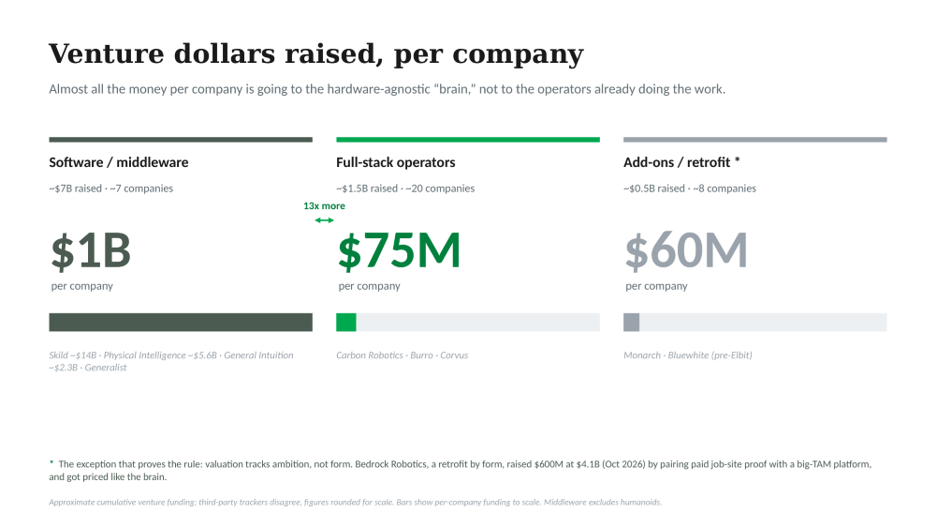
So the brain layer is taking in about 13 times the capital per company that the operators get.[2] But the real driver isn’t the layer, it’s the size of the prize: VCs pay up for a credible path into a huge market and little for a narrow point solution. Bedrock just raised $600 million at $4.1 billion on excavator retrofit kits,* priced like a brain because it pairs paid job-site proof with a big TAM.
Why it’s risky, even on venture math
I want to be fair to the people writing these checks, because the logic is sound on its own terms. You’re underwriting the chance that one of these models becomes the default brain for every robot on earth. If that happens, $6 or $14 billion looks cheap and the burn was a rounding error. One winner returns the fund, and that’s how most great venture outcomes get made.
But the entire thing rests on one assumption: that this is a winner-take-all market. And for robot foundation models, the machinery that normally produces a winner-take-all outcome is missing.
- There’s no obvious moat. Winner-take-all needs something that compounds and locks everyone else out: network effects, ecosystem lock-in, a proprietary data flywheel. A model trained on gameplay, public video, and simulation has none of those in a durable way. The inputs are available to the next team with a bigger cluster. No moat doesn’t give you a monopoly, it gives you a crowd of well-funded companies converging on the same capability.
- The value may not land at the model layer. NVIDIA already gives its robot model away to sell chips. The infrastructure player below is deliberately commoditizing the model layer, and the operators above own the deployment. Even the team that “wins” the model race may capture far less than a monopoly price implies, because the layers on both sides are working to make it free.
- You pay before you know. Whether any of this transfers from a clean demo to dependable paid work in dust, glare, and a warehouse that can’t tolerate a miscount is still unproven at scale. That’s the gate that decides whether there’s a winner at all, and the checks are being written before it’s cleared.
Bluewhite is an interesting acquisition
Here’s the part I keep coming back to. In May, Elbit Systems, a defense prime with about $7.9 billion in revenue and a $32 billion backlog, bought Bluewhite outright.[3] It didn’t want the tractor kit. It wanted the autonomy stack, the fleet software, and the 100,000-plus hours of real operating data behind them, proven on farms and in defense.
A company that could have funded any simulation program on earth decided it was cheaper to buy the real hours than to manufacture them. That should tell you something. The kit by itself is a feature. The kit wrapped in software and data is a company.
The takeaway
So the biggest bet in physical AI is riding on the layer with the least proof and the most dependence on the next check. One or two may genuinely become the winner, and I’d happily own that one. My worry is the whole category is priced as if each of them will, in a market that may never crown anyone.
The less glamorous trade is the operators already doing the work, already booking revenue, already sitting on the one asset that doesn’t get cheaper with time: data from the real world. It’s a longer road, and a harder story to tell in a pitch meeting.